Introduction to Planning for Elected Members Training
Introduction to Planning for Elected Members
Whether you are a newly elected member or simply looking for a refresher, the information on this page will help you understand how the planning system in Ireland works. It covers everything from plan‑making and planning applications to decisions, appeals, and the roles played by elected members, council staff, the public, and other stakeholders.
For more detail on the role and responsibilities of elected members in the planning process, please visit role of elected members in planning.
Training
Planning System in Ireland
Planning plays a vital role in shaping our communities. It helps us use land and resources wisely, supports necessary development, protects the environment and heritage of our towns, cities, and countryside.
Local planning authorities manage where and how development happens by deciding on planning applications. Elected members have an important role in making forward‑planning policies, such as development plans and area plans. These plans guide the proper planning and sustainable development of the area.
The hierarchy of plans in Ireland is set out below.
In 2018, the Government published the National Planning Framework (NPF) as part of Project Ireland 2040. It is the overarching policy and planning framework for Ireland’s:
- Social,
- Economic,
- Environmental, and
- Cultural development.
The NPF replaced the National Spatial Strategy as Ireland’s planning framework. The policies in the NPF must be taken into account when preparing Regional Spatial and Economic Strategies (RSES) and development plans.
Regional Spatial and Economic Strategies (RSES) have replaced the Regional Planning Guidelines. The objective of each RSES is to support the NPF and the economic policies and objectives of the government. Each strategy is a long-term planning and economic framework for the development of each region. Ireland is split into three strategic planning areas:
- Eastern and Midland Region,
- Southern Region, and
- Northern and Western Region.
These regions are governed by regional assemblies. Regional assemblies consist of members of the local authorities within the region. The regional assembly adopts the RSES.
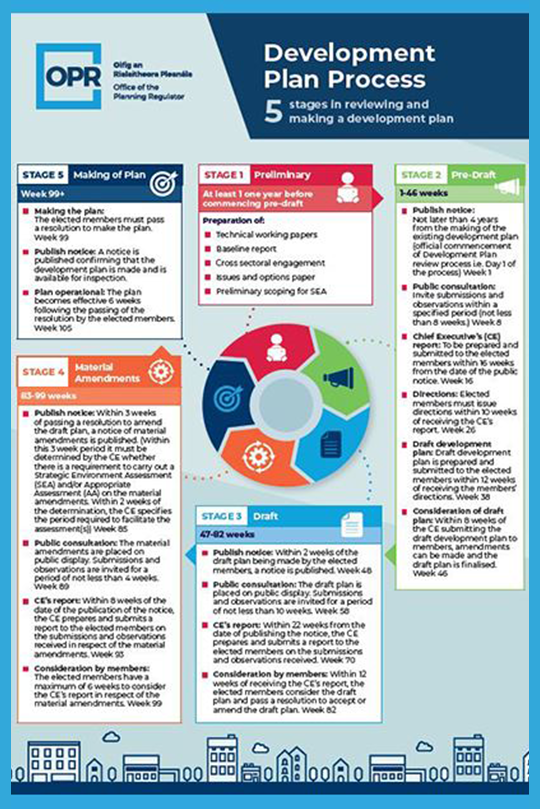
The development plan is the main public statement of planning policies for your local community. It sets out the land use, amenity and development objectives and policies of the planning authority, for a six-year period. The plan consists of a written statement of objectives and includes maps that give a graphic representation of how your city/county will develop and improve in a sustainable way in the six-year period. The core strategy of the plan shows that the plan is consistent with the National Planning Framework (NPF) and Regional Spatial Economic Strategy (RSES) policies.
Elected members (councillors) are responsible for making, reviewing and varying the development plan. It is their duty to adopt the plan with the technical help of their officials (the chief executive, planners, etc.). Public consultation on the plan must also be carried out.
A Local Area Plan (LAP) provides more detailed planning policies for areas where significant development and change is anticipated. A LAP must be compatible with national and regional guidance documents and the core strategy and policies of the development plan. A LAP is valid for six years from the date it is adopted by the planning authority.
1National Planning Framework (Department of Housing, Local Government and Heritage)
In 2018, the Government published the National Planning Framework (NPF) as part of Project Ireland 2040. It is the overarching policy and planning framework for Ireland’s:
- Social,
- Economic,
- Environmental, and
- Cultural development.
The NPF replaced the National Spatial Strategy as Ireland’s planning framework. The policies in the NPF must be taken into account when preparing Regional Spatial and Economic Strategies (RSES) and development plans.
2Regional Spatial and Economic Strategy (Regional Authorities)
Regional Spatial and Economic Strategies (RSES) have replaced the former Regional Planning Guidelines. Each RSES sets out a long‑term plan to support the National Planning Framework (NPF) and the Government’s economic policies and objectives. These strategies guide how each region should grow and develop over time.
Ireland is divided into three strategic planning regions:
- Eastern and Midland Region,
- Southern Region, and
- Northern and Western Region.
Each region is overseen by a regional assembly made up of elected members from the local authorities within that region. The regional assembly is responsible for preparing and adopting the RSES for their region.
3Development Plan (Planning Authorities i.e. County and City Councils)
The development plan is the main public document that sets out your local authority’s planning policies. It outlines how land should be used, what types of development are supported, and the goals for amenities and community growth over a six‑year period (under the Planning and Development Act 2000).
However, under the Planning and Development Act 2024 all new development plans will be made to cover a ten-year period. There will also be a five-year review so that the plan aligns with changing needs and circumstances.
The plan includes a written statement of objectives and maps showing how the city or county is expected to develop in a sustainable way.
The plan must also include a core strategy, which shows how it aligns with national and regional policies, including the National Planning Framework (NPF) and the Regional Spatial and Economic Strategy (RSES).
4Areas Plans (Planning Authorities)
Under the Planning and Development Act 2000, as amended, a local planning authority could make a Local Area Plan (LAP) for a specific area. This plan sets out detailed planning policies for places where major development or change was expected. It aligns national and regional planning guidelines and matches the core strategy and policies in the local development plan.
Once approved by the planning authority, the LAP remains in place for six years.
Under the Planning and Development Act 2024, three new types of focussed area plans are being introduced in lieu of LAPs i.e. Urban Area Plans, Priority Area Plans and Coordinated Area Plans.
Role of the OPR
The Office of the Planning Regulator (OPR) was set up in April 2019 following recommendations from the Tribunal of Inquiry into Certain Planning Matters and Payments (the Mahon Tribunal).
Our role is to make sure that local authorities and An Coimisiún Pleanála follow and apply Government planning policy.
We also carry out planning research and training, and work to improve public understanding of planning.
These videos explain more about the OPR’s role and the work done by our different teams.


Planning Leaflets
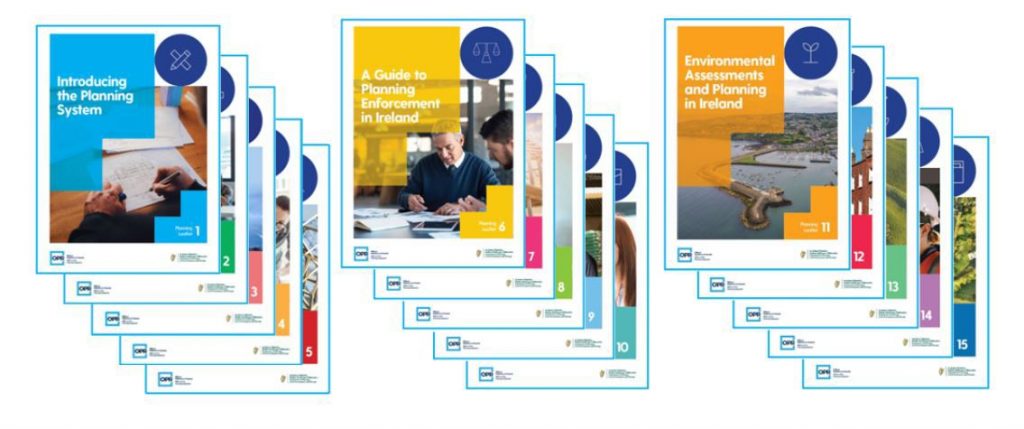
The OPR and the Department of Housing, Local Government and Heritage have created a series of planning leaflets that explain how the planning system works. The leaflets were published in early 2021 and updated in 2022 and are available to download on the Planning Leaflets page.
These leaflets cover many common planning topics, such as:
- How to prepare and submit a planning application
- How to make a planning appeal
- Rules for changing the use of a building or land
- Building extensions, garages and domestic sheds
- Agricultural developments
The leaflets are updated regularly to reflect changes in planning laws and policies.
Research Publications
Under the Planning and Development Act 2024, the OPR has a responsibility to carry out planning research.
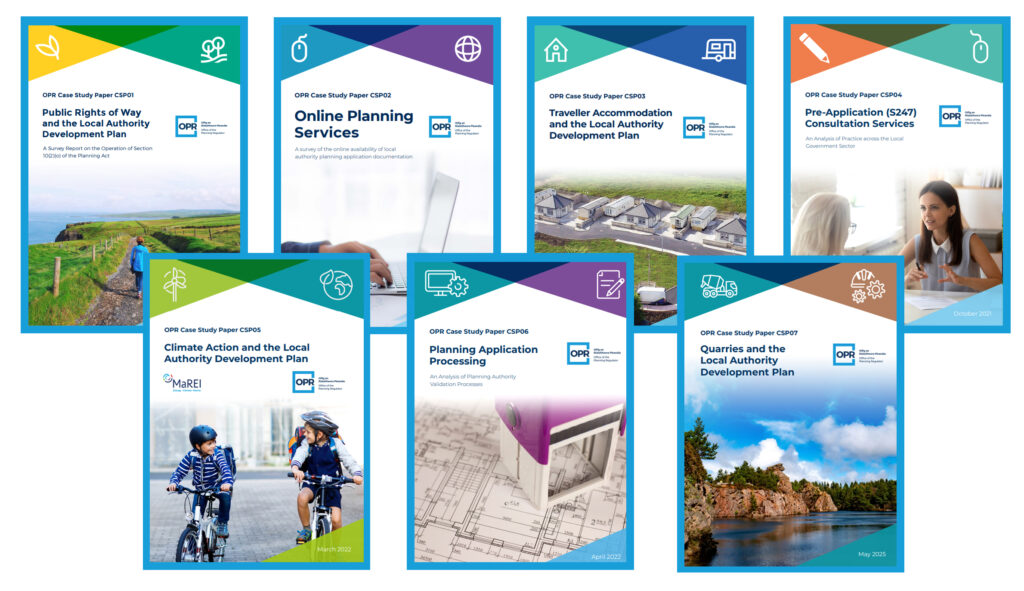
So far, the OPR has written and published a number of research reports:
- Case Study Papers (CSPs),
- Practice Notes (PNs),
- a Research Series Report (RSR), and
- other Research Reports.
This research is carried out in line with the OPR’s Planning Research Framework
To find out more about our research please visit our Research page. See our research reports here.



The Planning Process
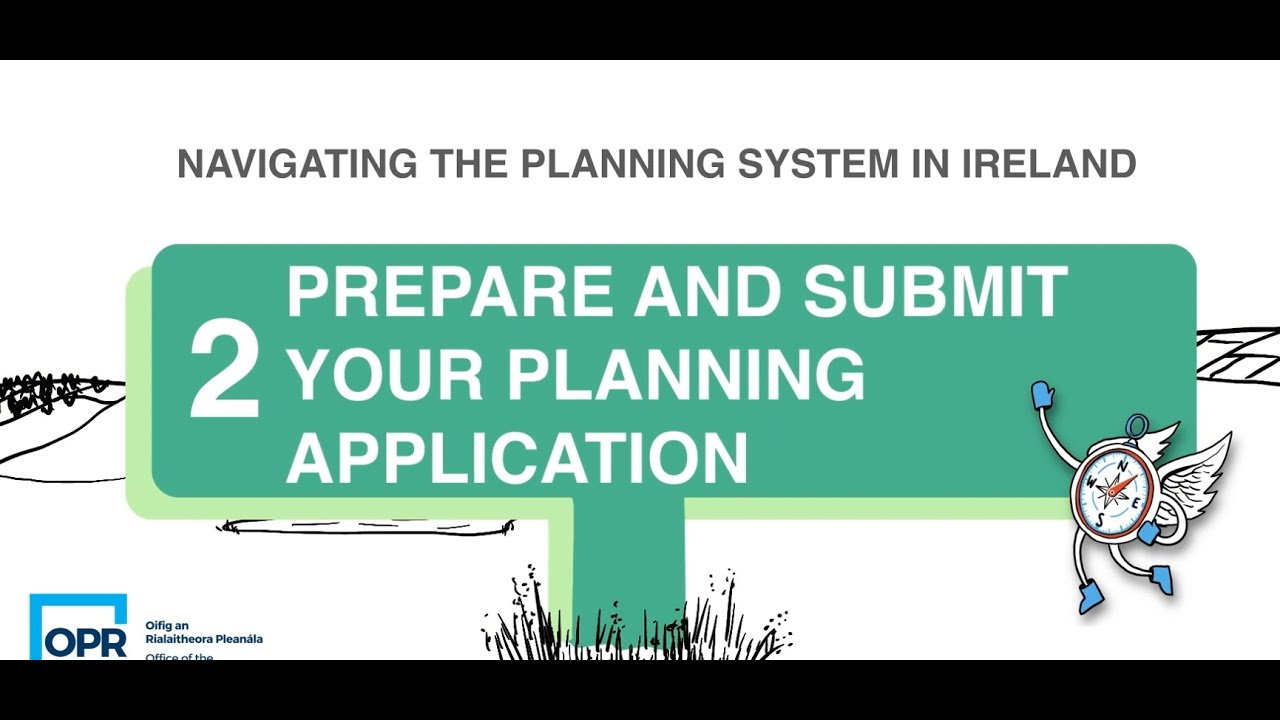
The OPR has developed an online Planning Process resource to make it easier to understand how the planning application process works.
It explains the three main stages of the process:
The resource includes short, animated explainer videos, simple flowcharts, and links to useful online planning information and leaflets. These materials are designed to help guide you through the planning system.
Additional Reading Materials