
Introduction to Planning
Introduction to Planning
This page gives you an introduction to the planning system. It explains the role planning plays in our society and how the system works. You can also learn about the different statutory plans, how they are made, and the role of the OPR.
You will find more information through our planning leaflet series and through episodes of the television programme Eco Eye that focus on planning. Links to both the leaflets and the Eco Eye episodes are provided below.
Our FAQ section includes answers to common questions and is updated regularly.
For more details on our research publications, and on training for elected members and staff of local authorities and regional assemblies, please visit the OPR’s Research and Training pages.
What is planning?
Planning plays a key role in shaping our towns, cities and countryside. It helps us use land and resources wisely, supports necessary development, and protects our environment and heritage.
Local authorities (also called planning authorities) decide where, how much and what type of development can take place by assessing and making decisions on planning applications. Everyone has the right to have their say on planning issues and to influence how their area develops.
For more information on how to comment on planning matters, please see our Planning Leaflet Series.
Hierarchy of Plans in Ireland
In 2018, the Government published the National Planning Framework (NPF) as part of Project Ireland 2040. It is the overarching policy and planning framework for Ireland’s:
- Social,
- Economic,
- Environmental, and
- Cultural development.
The NPF replaced the National Spatial Strategy as Ireland’s planning framework. The policies in the NPF must be taken into account when preparing Regional Spatial and Economic Strategies and development plans.
Regional Spatial and Economic Strategies (RSES) have replaced the Regional Planning Guidelines. The objective of each Regional Spatial and Economic Strategy is to support the NPF and the economic policies and objectives of the government. Each strategy is a long-term planning and economic framework for the development of each region. Ireland is split into three strategic planning areas:
- Eastern and Midland Region,
- Southern Region, and
- Northern and Western Region.
These regions are governed by regional assemblies. Regional assemblies consist of members of the local authorities within the region. The regional assembly adopts the Regional Spatial and Economic Strategy.
The development plan is the main public statement of planning policies for your local community. It sets out the land use, amenity and development objectives and policies of the planning authority, for a six-year period. The plan consists of a written statement of objectives and includes maps that give a graphic representation of how your city/county will develop and improve in a sustainable way in the six-year period. The core strategy of the plan shows that the plan is consistent with the National (NPF) and Regional (RSES) policies.
Elected members (councillors) are responsible for making, reviewing and varying the development plan. It is their duty to adopt the plan with the technical help of their officials (the chief executive, planners, etc.). Public consultation on the plan must also be carried out.
A local area plan provides more detailed planning policies for areas where significant development and change is anticipated. A local area plan must be compatible with national and regional guidance documents and the core strategy and policies of the development plan. A local area plan is valid for six years from the date it is adopted by the planning authority.
1National Planning Framework (Department of Housing, Local Government and Heritage)
In 2018, the Government published the National Planning Framework (NPF) as part of Project Ireland 2040. The NPF is Ireland’s main national policy for guiding:
- Social development
- Economic development
- Environmental protection
- Cultural development
The NPF replaced the National Spatial Strategy as Ireland’s national planning framework. Its policies must be considered when preparing Regional Spatial and Economic Strategies and development plans.
In 2025 the NPF was revised and updated and the First Revision to the NPF was published.
2Regional Spatial and Economic Strategy (Regional Authorities)
Regional Spatial and Economic Strategies (RSES) have replaced the former Regional Planning Guidelines. Each RSES sets out a long‑term plan for how its region should grow and develop. The aim is to support the National Planning Framework (NPF) and the Government’s wider economic policies and objectives.
Ireland is divided into three strategic planning regions:
- Eastern and Midland Region,
- Southern Region, and
- Northern and Western Region
Each region is managed by a regional assembly, made up of elected members from the local authorities within that region. The regional assembly is responsible for preparing and adopting the Regional Spatial and Economic Strategy.
3Development Plan (Planning Authorities i.e. County and City Councils)
The development plan sets out the goals and policies for land use, amenities and development in your area for a six‑year period under the Planning and Development Act 2000. However, under the Planning and Development Act 2024 all new development plans will cover a ten-year period. It will also include a five-year review period to ensure the plan aligns with changing needs and circumstances.
The plan includes a written statement and maps that show how your city or county is expected to grow and improve in a sustainable way over the period of the plan. The plan’s core strategy must also show how it aligns with national policy (the NPF) and regional policy (the RSES).
Elected members (your local councillors) are responsible for making, reviewing and changing the development plan. They adopt the plan with support from council officials such as the chief executive and planning staff. Public consultation is a required part of the process, so the community has an opportunity to give feedback and help shape the plan.
4Areas Plans (Planning Authorities)
Under the Planning and Development Act 2000, as amended, a local planning authority could make a Local Area Plan (LAP) for a specific area
A LAP set out detailed planning policies for places where significant development or change is expected. It had to be consistent with national and regional policies, as well as with the core strategy and policies of the local development plan.
Once adopted by the planning authority, a local area plan remained in place for six years.
Under the Planning and Development Act 2024, LAPs will be replaced by three new types of focussed area plans i.e. Urban Area Plans, Priority Area Plans and Coordinated Area Plans.
Why is planning important?
Planning helps make sure the right development happens in the right places and at the right time. This benefits local communities and supports the economy. It helps identify what kind of development is needed and where it should go. Planning also protects important areas, improves places that need it, and assesses whether proposed development is suitable.
What are the main features of the planning system?
The main features of the planning system are:
- preparing development plans,
- deciding when planning permission is needed,
- allowing some small‑scale works to go ahead without permission,
- appealing planning decisions, and
- taking action where development does not follow planning rules.
What is a development plan?
A development plan sets out the main planning policies for your local area. It explains how land can be used and what the planning authority wants to protect, improve and develop over the next six years as provided under the Planning and Development Act 2000.
However, under the Planning and Development Act 2024 all new development plans will be made to cover a longer ten-year period.
The plan includes written policies and maps that clearly show how the city or county is expected to grow and change in a sustainable way during that time. Its core strategy confirms that the plan follows national and regional planning policies.
Elected members (councillors) are responsible for preparing, reviewing and changing the development plan. They adopt the plan with technical support from council staff such as the chief executive and planning officials.
The public must be given opportunities to take part and share their views during the plan‑making process.
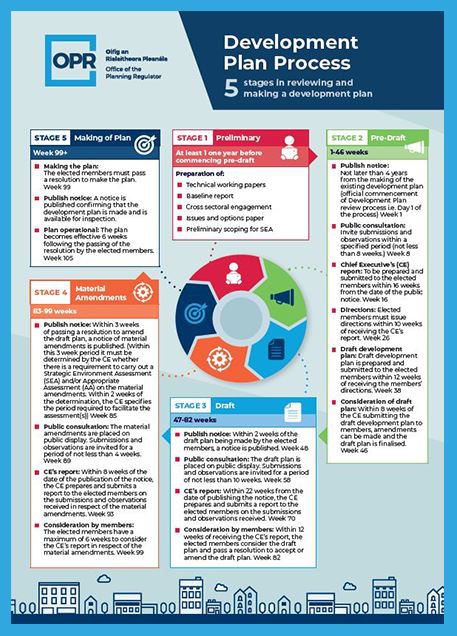
There are five key stages involved in making and reviewing a development plan (see infographic).
Elected members also decide on any changes to an existing development plan. To learn more, visit the “Role of Elected Members in Planning” page.
What is the role of the OPR?
The Office of the Planning Regulator (OPR) was set up in April 2019 following recommendations from the Tribunal of Inquiry into Certain Planning Matters and Payments (the Mahon Tribunal).
Our role is to make sure that local authorities and An Coimisiún Pleanála follow and apply Government planning policy properly.
We also carry out planning research, run training events, and work to improve public understanding of planning.
These videos explain more about the OPR’s role and the work of our different teams.


Planning Leaflets
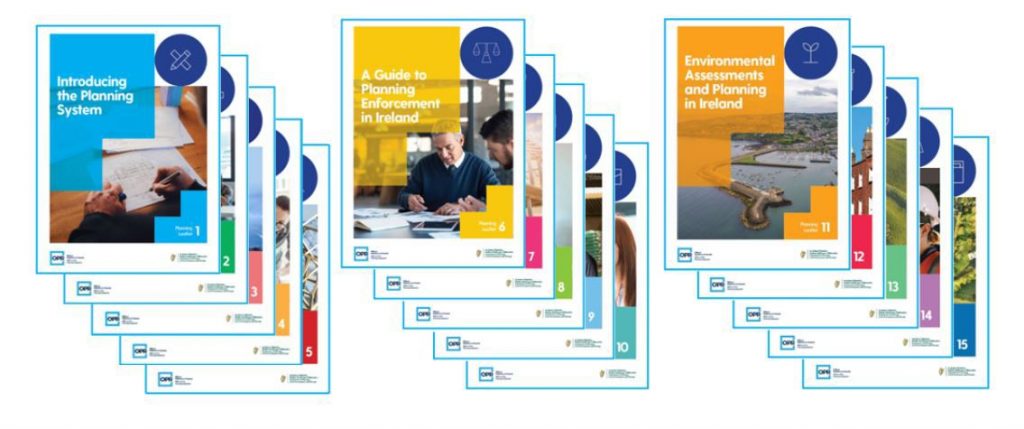
The OPR and the Department of Housing, Local Government and Heritage have created a series of planning leaflets that explain how the planning system works. The leaflets were published in early 2021 and updated in 2022 and are available to download on the Planning Leaflets page.
These leaflets cover many common planning topics, such as:
- How to prepare and submit a planning application
- How to make a planning appeal
- Rules for changing the use of a building or land
- Building extensions, garages and domestic sheds
- Agricultural developments
The leaflets are updated regularly to reflect changes in planning laws and policies.
Eco Eye Episodes
The OPR collaborated with the producers of Eco Eye, Ireland’s longest‑running environmental TV series, on several programmes about sustainable spatial planning.
Two episodes may be of particular interest: “A Place for Home” and “Planning Matters: Boyle Town”. You can watch these by clicking on the images opposite.
These episodes explain why sustainable growth is important and show how good planning helps create better places to live.
You can watch more Eco Eye episodes on sustainable spatial planning in our Media Library.
Frequently Asked Questions
To download a copy of the FAQs please click here.